Solve It
Build It


Role: concept originator, designer, and full-stack builder
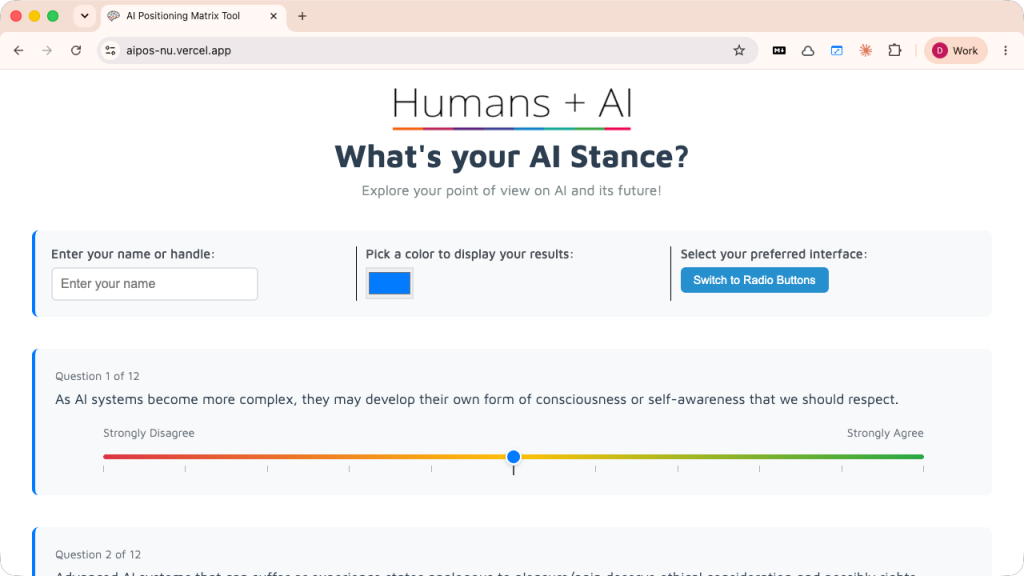
The opening of the assessment — Select your handle, ‘dot’ colour, and the first of 12 statements on an agree/disagree scale.
The Situation
The public conversation about AI tends to collapse into a single argument: are you for it, or against it?
That framing flattens genuinely different questions and pushes people toward camps rather than reflection. The H+AI community wanted to help its members explore their own views on a charged, fast-moving topic — honestly, and without being scored, ranked, or told which answer was the correct one.
The Work
Dan’s starting point was conceptual, not technical. He separated two questions the usual debate tangles together — how fast AI should advance, and whether AI is merely a tool or something with an inner life — and treated them as orthogonal axes rather than a single pro-or-anti spectrum. That is the intellectual core of the tool: it lets someone hold a position the one-dimensional version cannot express, such as strongly pro-acceleration and firmly “AI is just a tool.”
He then built the framework into a working instrument — a short self-assessment that places the participant on a two-axis matrix and hands back layered reflection questions instead of a grade. One design rule runs through all of it: no quadrant is the “right” one, and every position is written up with equal respect. Beneath the surface, the feedback text is pre-written and chosen by position rather than generated at runtime, so everything a participant reads is reviewable, consistent, and calm in tone — a deliberate choice for a sensitive subject.
See where you land — the assessment takes about five minutes and drops your dot onto the shared matrix, alongside other recent participants.
Download or fork the AIPOS app on GitHub.
The Turn
The first build was ambitious: 16 questions, a server-side backend, and server-generated PDFs. In production it broke — the serverless functions crashed erratically because they leaned on in-memory state that a stateless execution model cannot hold. Rather than patch around the symptoms, Dan re-scoped pragmatically: cutting to 12 questions, moving to a client-only architecture, and replacing the PDF service with the browser’s own print capabilities. The call traded feature complexity for reliability, leading to an improved, streamlined experience.
The Result
AIPOS shipped as a live, freely licensed instrument and found its audience in the community it was built for. It has been used by the H+AI Explorers Community, the BC+AI community’s Mind, AI & Consciousness working group, is shared freely on LinkedIn, and prompted Barry J Barresi to propose a customized version to use with his university colleagues — the kind of adaptation the tool invites. By design it stores almost nothing about its participants, so the evidence is qualitative and relational rather than a usage metric: an engaged early audience, and a real request for more.
Client Voice
Excellent! A very good experience, very easy and clear.
— Ross Dawson, founder, Humans + AI community
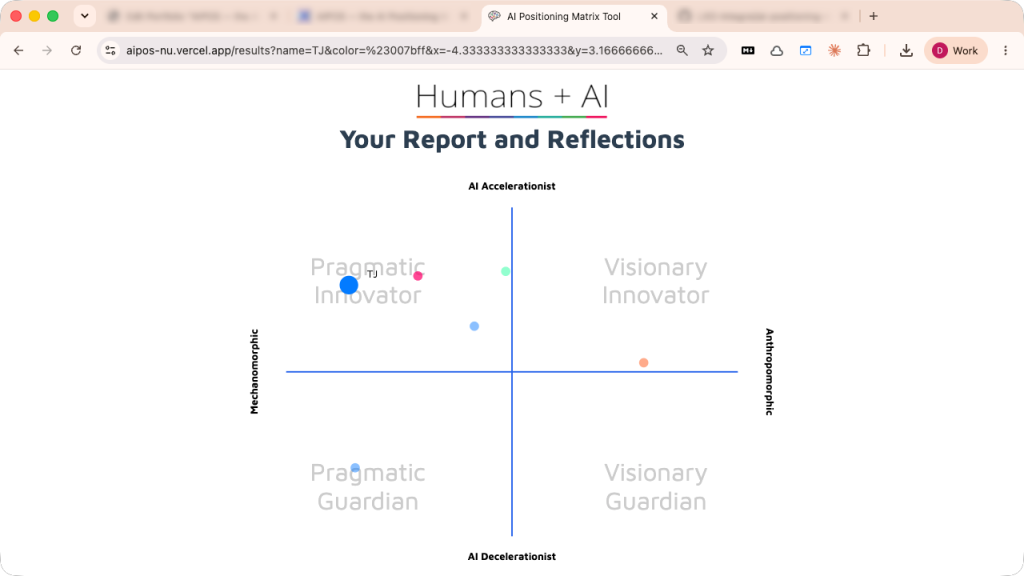
The framework itself — pace of development on one axis, how we regard AI’s nature on the other, with four archetypes at the corners. Responses accumulate over time, slowly fading away over a preset time period, allowing a user to anonymously compare their positioning with others.